
Temporary Installations for FIFA & Olympic-Scale Events: Challenges & Best Practices

Global events like the World Cup and the Olympics run on fixed dates. Everything must be installed before the first fan walks in. Temporary builds help cities meet demand without overbuilding permanent structures.

The challenge is execution. Tight access windows, multiple stakeholders, and zero room for delay mean every fixture, sign, and millwork detail must be installed correctly the first time. With strong site planning, phased installs, and clear project tracking, large-scale environments stay on schedule. That is where disciplined, hands-on installation teams make the difference.

When the world tunes in to the FIFA World Cup or the Olympic Games, everything must be ready. Signage must be installed. Sponsor activations must be built. Pop-up retail stores must open on time. There is no second chance once the gates open.

Temporary installations make these global events possible. But they demand precision, coordination, and disciplined execution.

Why Temporary Installations Power Mega Sporting Events

Mega sporting events operate at a massive scale. According to the World Economic Forum, the global sports industry generates approximately $2.3 trillion in annual economic activity, representing nearly 2% of global GDP. That scale creates pressure. Host cities must deliver world-class venues, sponsor environments, and retail spaces quickly. At the same time, they must avoid long-term waste and underused infrastructure.

Temporary installations solve this problem.

They allow cities to:

  • Build for peak demand
  • Reduce long-term maintenance costs
  • Deploy faster than permanent construction
  • Lower environmental impact
  • Support better legacy planning

Modern event planning focuses on adaptability. Temporary does not mean lower quality. It means strategic infrastructure. The International Olympic Committee reports that 86% of permanent Olympic venues remain in use, reflecting the shift toward smarter venue planning and reduced overbuilding.

Temporary installations are part of that evolution.

What Makes FIFA and Olympic Installations Different

Temporary event installations at global scale differ from standard retail or commercial projects.

They involve:

  • Strict international standards
  • Multiple governing bodies
  • International broadcast exposure
  • Fixed, immovable deadlines
  • Multi-city coordination

There is no soft launch. There is no phased public opening.

When the event begins, millions are watching. Access windows are tight. Security is controlled. Approvals require documentation. Every fixture, sign, and branded element must meet safety and compliance standards.

Execution matters more than marketing language.

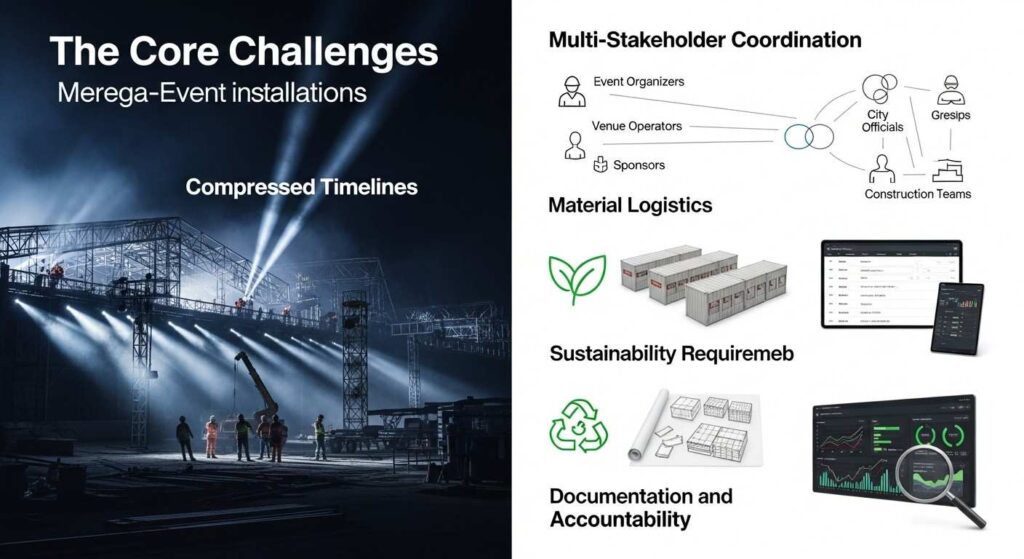
Core Challenges in Temporary Mega Event Installations

Mega Event Installations

Before discussing best practices, it is important to understand the risks.

Compressed Timelines

Event dates are fixed years in advance. Installation windows, however, are often limited to weeks or even days. Crews may work overnight. They may share access with other trades. Delays in one area can affect the entire venue.

Multi-Stakeholder Coordination

Olympic and FIFA-scale events involve:

  • Event organizers
  • Venue operators
  • Sponsors
  • City officials
  • Construction teams

Clear communication is critical. Misalignment slows progress.

Material Logistics

Temporary venues often have limited storage space. Deliveries must be scheduled precisely. Materials cannot sit onsite for long. Every shipment must arrive when needed.

Sustainability Requirements

Modern mega events prioritize environmental responsibility. Installations must:

  • Minimize waste
  • Allow dismantling
  • Support reuse
  • Avoid permanent damage

Temporary builds must still meet high performance standards.

Documentation and Accountability

Large budgets require transparency. Stakeholders need proof of progress. Field reporting must be clear and organized. Without structured tracking, risk increases.

Best Practices for Temporary Event Installations

Mega event success depends on preparation and visibility. Based on global event guidelines and field experience, these best practices improve outcomes.

Start With Site Surveys and Field Validation

Accurate measurements prevent costly errors. Before materials arrive, we conduct site surveys and document:

  • Wall conditions
  • Structural surfaces
  • Mounting constraints
  • Access routes
  • Clearance limitations

Clear documentation reduces surprises.

Use Phased Execution Planning

Temporary installations must follow logical sequencing:

  1. Fixtures
  2. Signage
  3. Millwork adjustments
  4. Finishing details

Each phase depends on verified completion of the previous one. This structure protects timelines.

Adopt Modular Installation Strategies

Modular systems speed up installation and simplify removal.

They allow:

  • Faster assembly
  • Reduced material waste
  • Easier dismantling
  • Controlled storage

Temporary environments benefit from flexibility.

Maintain Real-Time Project Visibility

High-stakes environments require full transparency.

With CONNEXT, our internal project tracking platform, we provide:

  • Live progress updates
  • Field photos
  • Centralized documentation
  • Timeline tracking

Stakeholders stay informed without confusion.

Clear visibility supports faster decision-making.

Deploy Dedicated Rollout Teams

Mega events often span multiple cities or venues. Consistency matters.

Our multi-location rollout experience ensures:

  • Uniform branding standards
  • Controlled timelines
  • Coordinated execution
  • Reduced communication gaps

Scalable teams reduce operational stress.

Stay Adaptable Onsite

Temporary environments change quickly. Sponsor updates may occur days before launch.

Our crews adjust to:

  • Revised graphics
  • Layout changes
  • New fixtures
  • Unexpected site conditions

Adaptability protects deadlines.

Lessons From Olympic Temporary Venue Strategy

Recent Olympic planning emphasizes sustainability and reuse. The 86% venue reuse statistic shows a shift toward long-term thinking.

Temporary venues contribute to that success by:

  • Reducing post-event underuse
  • Supporting responsible spending
  • Allowing flexible branding
  • Avoiding unnecessary permanent builds

Temporary installations must meet global standards while protecting future city planning.

That balance requires disciplined execution.

Where Retail Installation Expertise Fits In

Large sporting events include more than stadium seating. They include:

  • Sponsor pop-ups
  • Merchandise stores
  • Hospitality suites
  • Fan zones
  • Branded activation spaces

These environments function like retail spaces.

They require:

  • Fixture setup
  • Sign and graphics install
  • Vinyl wall wraps
  • Custom millwork installation
  • Merch display configuration

Retail environments must open on time. That same discipline applies to mega event installations.

At Teamwork, we focus on hands-on execution.

We install per plan.
We coordinate efficiently.
We keep projects on time and on brand.

The Role of Project Visibility in High-Stakes Installations

Global event guidelines emphasize governance and accountability. At this scale, documentation is not optional.

Project visibility reduces risk by allowing stakeholders to:

  • Confirm milestone completion
  • Review site photos
  • Track schedule alignment
  • Access organized records

CONNEXT centralizes that information.

When everyone sees the same data, decisions move faster.

Future-Proofing Temporary Installations

FIFA’s infrastructure guidance emphasizes adaptability. Installations must allow change.

Future-ready temporary installations include:

  • Reusable structural systems
  • Non-destructive mounting methods
  • Modular signage frames
  • Efficient dismantling plans
  • Material recovery strategies

Temporary does not mean disposable. It means planned for lifecycle control.

How We Support Large-Scale Installation Demands

Teamwork specializes in precise installation services that align with temporary event environments.

We provide:

  • Retail installation services
  • Sign and graphics install
  • Custom millwork installation
  • Pre-construction surveys and audits
  • Pop-up retail buildouts
  • National rollout services

With CONNEXT, clients stay informed through live updates, site photos, and accurate timelines in one place.

Execution That Holds

Temporary installations are essential to FIFA and Olympic-scale events. They allow host cities to meet peak demand without long-term infrastructure burden. But success depends on structured planning, disciplined crews, and real-time visibility.

From site surveys to final signage retail install, precision determines whether venues open on schedule. If you need reliable installation services for large-scale pop-ups, retail environments, or multi-location rollouts, we are ready to execute.

Frequently Asked questions

Brand activations are immersive physical experiences created by sponsors to engage fans through retail-style environments, signage installations, pop-ups, and interactive displays within and around event venues.

Because they attract large audiences and generate significant economic activity. This scale encourages brands to build larger, more immersive physical environments.

They require coordinated rollout schedules, consistent branding standards, and centralized project tracking to maintain uniform presentation across venues.

Retail installation ensures that fixtures, signage, and millwork are securely and professionally installed before event milestones.

Real-time visibility supports coordination across multiple sites and helps keep projects aligned with event timelines.

Teamwork inc logo

At Teamwork, we’re proud of our experienced and dedicated team, who work together seamlessly to deliver top-tier retail rollouts, remodels, and brand activations. Each member brings a unique skill set and a passion for excellence, ensuring every project is executed with precision.