
Checklist
Flawless Graphics. Perfect Displays. Every Time.
By Teamwork
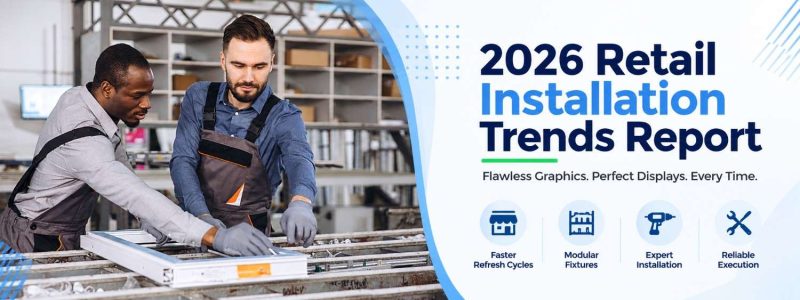
Retail is entering a faster and more demanding era. Stores refresh more often, materials are changing, timelines are shorter, and consumers expect higher levels of visual precision. Installation is no longer a final step at the end of a project. In 2026 it becomes a strategic capability that determines how quickly a brand can execute ideas across its store network.
Several forces are driving this shift.
1. Physical Stores Now Refresh at the Speed of Digital
Retailers update their environments more often to match rapid product drops, social trends, and seasonal storytelling. Walls, windows, and fixtures change frequently, supported by:
large format vinyl
Brands that once refreshed quarterly now refresh monthly or faster.
Installation teams must keep up with this pace while maintaining consistent quality.
2. Planning Timelines Are Shorter and Less Predictable
Marketing calendars tighten, supply chains shift, and design approvals often happen closer to the install date. Rollouts now launch in waves, and materials frequently arrive with less lead time than expected.
Installation teams must be ready to mobilize quickly, adjust to updated plans, and deliver reliable documentation under tighter windows.
3. Materials Are Becoming Lighter and More Modular
Retail fixtures are evolving to support faster builds. Teams now work with:
These materials speed up installs but require technicians who understand precise handling and clean finishing methods.
4. Pop Ups and Experiential Concepts Are Increasing
Brands use physical spaces for short term concepts, event driven builds, and rapid activations. These formats call for:
Short duration builds now make up a larger share of installation work.
5. Retailers Expect Real Time Visibility
Teams want clear, immediate updates on every location, including:
Platforms such as Teamwork’s CONNEXT support this expectation by keeping project managers and field crews aligned at every stage.
Why This Report Matters
Retail in 2026 demands faster refresh cycles, more adaptable materials, tighter timelines, and higher craftsmanship standards. This report explains the major forces shaping installation, the trends affecting future store environments, and the capabilities retailers need to execute consistently across all locations.
Retail installation is no longer a static craft; it is a fast-moving operational discipline shaped by design complexity, rising consumer expectations, and unpredictable development cycles. In 2026, stores behave more like live environments than fixed builds, requiring installation teams that can execute with precision, speed, and adaptability. The forces below explain why the installation function has become central to modern retail success.
1. Acceleration of Retail Refresh Cycles
Across retail verticals, stores are refreshing at a significantly faster cadence. This acceleration is driven by:
Faster merchandising calendars
Seasonal takeovers + environmental storytelling
Marketing behaving like digital content
Installation Impact:
Installers face more frequent work, tighter windows, faster turnovers, and heavier material throughput per site.
2. Higher Consumer Expectations for Store Precision
Modern shoppers expect stores to be cohesive, intentional, consistent, and flawlessly executed.
Customers now:
Small execution errors, misaligned vinyl, uneven fixtures, imperfect seams, are more visible in today’s high-end design language.
Installation Impact:
Installers must deliver premium-quality finishing at scale, across multiple stores, with zero variation.
3. Material Shifts and the Move Toward Modular Systems
Retail development is shifting toward materials that support speed, sustainability, and reconfiguration. Key transitions include:
These innovations shorten build times but require installers who understand how new materials behave.
Installation Impact:
Crews must adapt to new materials, new tolerances, and new techniques, all while maintaining consistency and speed.
4. Supply Chain Variability + Compressed Timelines
While more stable than past years, supply chain variability persists in:
This compression affects every downstream task.
Installation Impact:
Install teams become the “shock absorbers” of the schedule, expected to execute flawlessly despite late arrivals and condensed timelines.
5. Rise of Pop-Ups, Seasonal Stores & Short-Run Experiences
The retail industry is expanding into flexible formats such as:
These environments demand fast setup, premium finishing, and clean removal, often under extreme time pressure.
Installation Impact:
Work has become more time-sensitive, high-visibility, and skill-intensive, requiring crews that can mobilize quickly and deliver elevated finishes.
6. Multi-Location Consistency as a Strategic Priority
National rollouts require every store to reflect the same:
Design teams create the concept but installation determines consistency at scale.
Installation Impact:
Installers must work using precise measurement standards, duplicable processes, and robust documentation to ensure identical execution across markets.
7. Demand for Real-Time Visibility & Project Documentation
Retailers increasingly require real-time clarity on:
Distributed teams make centralized reporting essential.
Modern platforms (e.g., CONNEXT) enable:
Installation Impact:
Communication can no longer rely on email threads, installers must provide organized, real-time reporting for every site.
8. Evolving Labor Skill Requirements
Today’s installation teams must navigate:
Installers must be both craftsmen and problem-solvers, capable of adjusting to unique site conditions.
Installation Impact:
Retailers increasingly value installation partners that invest in training, specialization, and unified processes across all crews.
9.Sustainability & Waste Reduction Pressures
Retailers are adopting more circular, low-impact installation ecosystems that emphasize:
These systems reduce waste but require more care and technique from installers.
Installation Impact:
Teams must know how to store, reinstall, and handle sustainable materials without damage, supporting circularity without compromising execution quality.
Three structural forces are pushing retailers to adopt adaptive environments:
1. Faster Consumer and Merchandising Cycles
Shorter product trends, rapid drops, and faster consumer adoption patterns make slow store updates impossible.
2. Growing Demand for In-Store Experiences
Brands need to update environments more often to stay relevant and align with weekly or monthly storytelling.
3. Operational Pressure to Do More With Less
Retailers face shrinking square footage, labor constraints, and rising remodel costs. Adaptability becomes a cost-control strategy.
What Adaptive Retail Actually Looks Like
These stores behave more like physical content platforms than static spaces.
Strategic Implications for Retailers
Moving to adaptive systems has broad organizational impact:
Adaptability becomes a measurable operational capability.
Regional Outlook
North America
Competitive pressure and consolidation accelerate adoption.
Europe
Sustainability goals and strict space utilization standards push modular, reusable systems.
Asia-Pacific
Highly experiential retail markets update most frequently, leading global experimentation.
2026 Forecast
By late 2026, adaptive retail becomes mainstream:
What Retail Leaders Should Prepare For
Early adopters will move faster, spend less, and outperform on experience relevance.
What’s Changing
Retailers are phasing out heavy, fixed fixture packages and replacing them with modular, tool-less systems that install faster, cost less to maintain, and support continuous store evolution.
By 2026, modularity becomes the expected baseline for new builds and refresh programs.
Why This Trend Is Accelerating
Three operational realities are pushing retailers toward modular and tool-less ecosystems:
Faster Visual and Merchandising Cycles
Campaigns, signage, and product displays now change weekly or monthly, making traditional, labor-intensive fixture systems too slow and too costly.
Labor Scarcity and Rising Field Costs
Retailers cannot rely on large, specialized install crews. Tool-less systems reduce labor requirements and simplify national rollouts.
Cost Pressure and the Need for Scalable Consistency
Modular systems reduce variance, increase predictability, and ensure every location can be updated rapidly using the same fixture backbone.
What Modular Retail Actually Looks Like
Modern modular ecosystems focus on speed, reusability, and ease of installation:
Strategic Implications for Retailers
Transitioning to modular systems reshapes both operational and financial models:
Regional Outlook
North America
Leading adoption due to labor shortages and the scale of national rollouts.
Europe
Driven by sustainability mandates and strong reuse requirements.
Asia-Pacific
Fastest adoption curve due to rapid trend cycles and compact store formats.
Regardless of region, retailers are converging on the same outcome: standardized, flexible, fast-to-change fixture systems.
2026 Forecast
By late 2026:
What Retail Leaders Should Prepare For
What Retail Leaders Must Prepare For
Executive teams should begin building strategies around:
This shift will define the operational winners of the next retail cycle.
What’s Changing
Sustainability is no longer a corporate talking point. By 2026, it shapes how retailers select fixtures, materials, and installation strategies. Environmental considerations are tied directly to cost, operational efficiency, and consumer perception.
Why This Trend Is Accelerating
Three major forces drive the shift:
1. Regulatory Momentum
European, UK, and several U.S. state regulations target waste reduction and circular materials.
2. Corporate ESG Commitments
Reporting requirements for carbon footprints, supply chain transparency, and ESG compliance are increasing.
3. Consumer Expectations
Shoppers value visible sustainability in stores, influencing brand choice and loyalty.
Additional pressures include rising disposal costs and a need to reduce landfill impact.
What Sustainable Retail Actually Looks Like
Note: Stores operate as modular, circulatory systems that minimize waste.
Strategic Implications for Retailers
Campaign planning prioritizes reusable hardware
Material choice impacts install speed, handling, and disposal requirements
Lighter materials reduce labor demand and shipping costs
• Sustainability becomes a competitive differentiator, especially in fashion, beauty, and lifestyle
• Installation excellence now includes environmental efficiency
2026 Forecast
By 2026:
Executive Actions for Retail Leaders
Note: Teamwork Specialists in retail installation, fixture setup, graphic and signage installs, vinyl wall wraps, custom millwork, pop-up buildouts, and national rollouts. Delivering precision, accountability, and brand consistency, every time.
Summary
This installation QA checklist helps retail teams verify graphics, signage, fixtures, shelving, safety, alignment, documentation, and final presentation. It helps identify issues early, maintain brand standards, improve accountability, and ensure consistent, high-quality store rollouts.
Request Estimate
Download the printable PDF version of this checklist and keep it on-site for your next rollout or remodel. With Teamwork, you’ll always have a clear path to a successful install.